
The Sibley County Most Wanted Program
A most wanted page is a public-safety tool, not a records system. An agency picks a few cases, posts basic details, and asks the public for help finding the people named. The list shows enforcement priorities, not the full count of outstanding warrants. Sibley County runs no such program. The Sheriff's site, the county form center, and the county navigation pages carry no most wanted roster, no warrant list, and no fugitive page. The county's own quick links send visitors to custody information, state agencies, and statutes instead. Note: a program page is a curated selection, and the lack of one says nothing about whether a warrant exists in any given case.
No Sibley Most Wanted Warrant Roster
Some readers expect a county to post a wanted list because big metro agencies do. Sibley County keeps no such roster, so there is nothing to read, update, or measure. That removes a worry as much as a tool. Nobody can appear on a Sibley County most wanted page because none exists. The county's public pages stay pointed at custody information, the state Bureau of Criminal Apprehension, and statute references rather than at any warrant publication, and nothing in the county materials hints that a program is in the works.
How the Lists Work
Where a program does operate, the list is built by hand. An agency weighs how serious the case is, how long the person has been at large, and whether public attention would help. Entries come off the page as cases close, so what you see is a snapshot rather than a live feed. A listed case is still a case, with a court, a charge, and a status that only the issuing jurisdiction can confirm. Program pages rarely say whether a warrant has been served or recalled since the entry went up, and they never cover the warrants left off the list. For anyone checking their own status, that gap matters. The real question is not whether a name shows up on a program page in Sibley County. It is whether the court has an open order in the case.
Sibley Warrant Lookup vs State Tips
Minnesota runs a public tip route through the Bureau of Criminal Apprehension, and it is built for information about cases rather than record checks. The state tip submission interface takes a tip, explains the anonymity options, and sends emergencies to 911. It returns no warrant status and no custody result. It is an official channel for information, not a most wanted roster and not a Sibley County lookup tool.
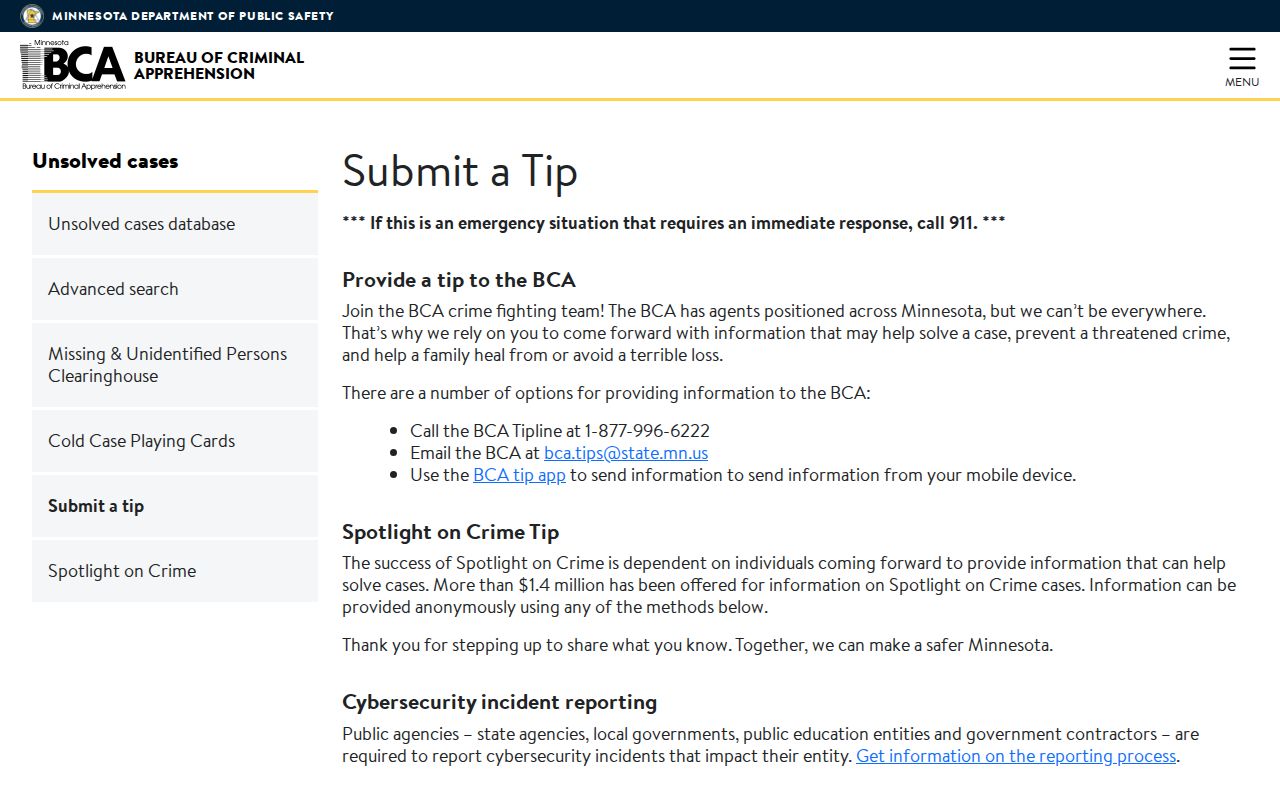
Use that route to pass along information in Sibley County, and use Court Administration to ask about a case.
How to Report a Tip Safely
A tip helps when it reaches the right office with enough detail to act on. Do not approach a person who may be wanted. Do not try to confirm a warrant yourself before reporting what you know. The right offices serve Sibley County.
Tip basics: report to the agency handling the case, give the time and place you observed something, and use the state or local route that offers anonymity if you want it.
- Call 911 for anything happening now or anyone in danger
- Contact the Sibley County Sheriff's Office at 507-237-4330 for a county matter
- Use the state Bureau of Criminal Apprehension tip portal for a state case
- Give facts you observed rather than conclusions about a person
- Ask about anonymity and rewards before you give your details
Sibley Warrants and Federal Most Wanted
The U.S. Marshals Service runs its own 15 Most Wanted program, and it works in a different jurisdiction from Sibley County. That federal program covers federal fugitive cases. The Marshals District of Minnesota handles federal process for this region. A name on a federal list is a federal matter. A federal warrant will not appear in a Sibley County file, and a county record cannot clear it. The U.S. Marshals program page shows how a curated list works and why it is not a database, and the District of Minnesota page covers the Marshals office for this region.


A federal question belongs with federal counsel or the federal clerk, not with the Sibley County court.
Most Wanted vs an Active Warrant
The two are often treated as the same thing, and they answer different questions.
| Point | Most Wanted Program | Active Warrant |
|---|---|---|
| Scope | A limited selection of cases | Every open order in a court system |
| Who decides | Agency discretion | The issuing court and the case history |
| How it is used | Public attention and tips | Case confirmation and resolution |
| Sibley County status | No program located | Confirmed by the court and the Sheriff |
A curated page is never a complete list. A Sibley County name left off one is never proof of a clean record.
Why Sibley Warrant Profiles Stay Official
A roster copied onto a private site can follow a person long after a case closes. A copy also loses the agency's updates, disclaimers, and removal process. The official program page keeps all of that. The practical rule is simple: official sources for Sibley County are described and linked, and their contents stay where the agency can maintain them.
If You Believe You Are on a List
Do not call the tip line about your own case. Do not send a public tip with your details. A person checking their own status in Sibley County should speak with the court and an attorney instead.
Important: contact Court Administration and a lawyer before any in-person appearance, because Minnesota courts warn that appearing with a warrant can result in custody.
If a federal program is involved, use federal counsel and the federal clerk. A Sibley County case and a federal case are separate files with separate answers.
No Sibley Warrant Roundup Found
Sibley County runs no warrant roundup. No amnesty week, no no-arrest docket, and no fee-waiver campaign appear on the Sheriff's pages, the county press index, the court pages, or the city pages. An official amnesty promise would change the usual advice, but none exists here. So the ordinary path stands. Confirm the case with the issuing court, ask about a recall or a new court date, and contact the Sheriff before you appear. One statewide change does affect these cases in Sibley County: the sign-and-release procedure under Minnesota Statutes 629.415. That procedure covers qualifying failures to answer a summons, not every outstanding warrant.